
The Challenge
Deicers Are Hard
On Concrete
Road salt and brine keep winter roads clear. They also contribute to scaling, freeze-thaw damage, and rebar corrosion, which shortens the service life of pavements and bridge decks.
The deicer in concrete pores changes how, when, and where ice forms inside the concrete. Some deicing chemistries also react with the cement paste itself — accelerating damage beyond what water alone would cause.
E5® Nano Melt Is Different.
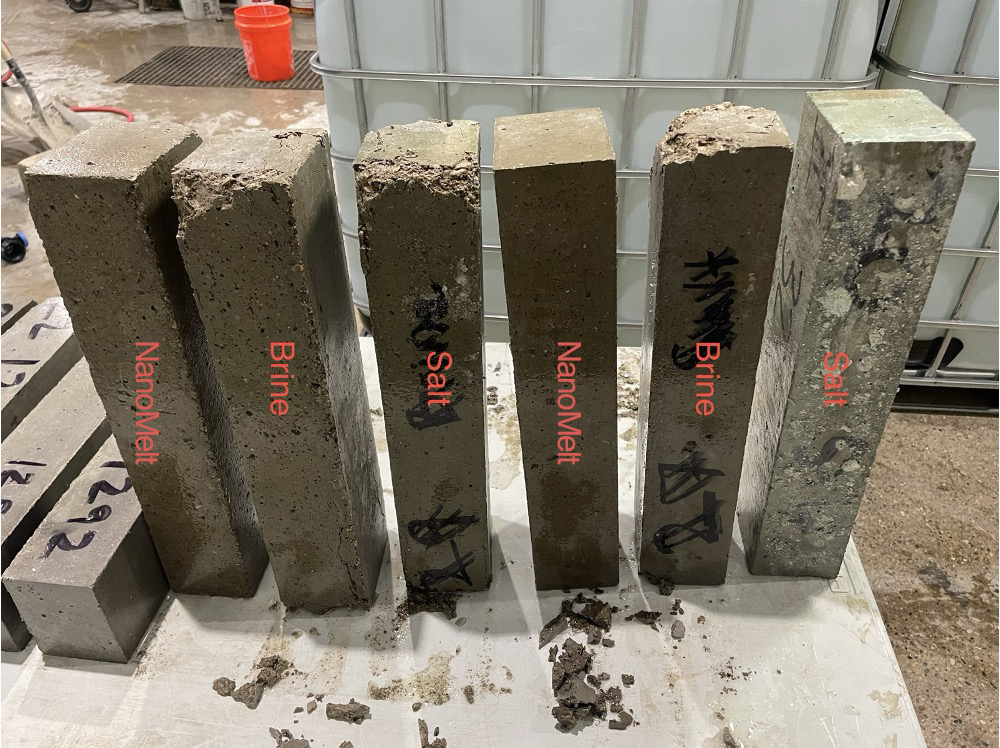
We checked that directly. Same concrete, same freeze-thaw cycling, three deicers side by side. The E5® Nano Melt beams lost some stiffness. The salt beams lost nearly all of it.
Only deicer above 60% RDM
Stayed well above the ASTM C666 failure threshold
Over 5× the stiffness of brine
Beams retained dynamic modulus where brine beams failed
Square, intact edges
No spalling where brine and rock-salt beams scaled badly
Consistent across both cements
Type I and Type IL ranked the deicers the same way
Full-strength exposure test
Soaked — not diluted — the most demanding condition
Longer pavement service life
Less stiffness loss means more structural integrity over time
Bridge decks & pavements
Applicable wherever conventional deicers cause damage
E5® Nano Silica technology
Powered by the same nano silica platform as E5's admixtures